
- Topics 1570
- Industrial 60
- Troubleshooting Guides 32
- Restaurant Management 145
- Bar Management 69
- Catering Tips 43
- Bakery Management 44
- Food Trucks & Concessions 36
- Advertising & Marketing 41
- Eco-Friendly Tips 13
- Facility Layout & Design 47
- Coffee Shop Tips 32
- Installation & Maintenance 63
- Janitorial & Pest Control 34
- Safety & Sanitation 122
- Startup Tips 110
- Menu Design 13
- Kitchen & Cooking Tips 108
- Hospitality Management 25
- Pizza & Sandwich Shop Tips 21
- Smallwares 42
- Food Prep 103
- Tabletop Items 21
- Disposables 28
- Calculators & Tools 7
- Consumables 77
- Warewashing & Laundry 22
- Cooking Equipment 107
- Food Storage & Refrigeration 57
- Beverage Equipment 42
- Office Supplies 6

Commercial juicers are the workhorses behind fresh-squeezed OJ programs, cold-pressed juice bars, smoothie stations, and made-to-order beverage menus in everything from breakfast diners to juice shops and grab-and-go markets. Picking the right one comes down to matching horsepower, feed style, and production to your order volume, since an underpowered juicer will bottleneck service just as easily as an oversized one wastes counter space and budget. Below, we showcase the top commercial juicers and highlight the attributes that make them must-have juice equipment:
Shop All Commercial Juicers
- Best Overall Juicer: Robot Coupe C80 Stainless Steel Continuous Feed Automatic Sieve
- Best Citrus Juicer: Sunkist J-1 Commercial Citrus Juicer
- Best Juice Extractor: Robot Coupe J100 Juicer with Continuous Pulp Ejection
- Best Countertop Juicer: Waring BJ120C Compact Bar Citrus Juicer
- Best Manual Juicer: Garde MCJ-1 Heavy-Duty Manual Commercial Citrus Juicer
- Best Budget Juicer: AvaMix CJ1400 Electric Stainless Steel Citrus Bar Juicer - 120V, 1,400 RPM
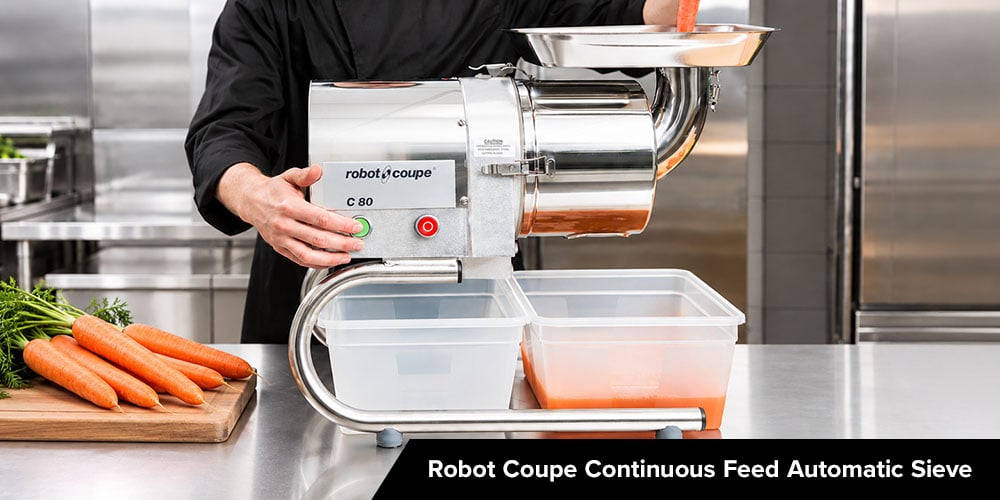
For operators running a high-volume juice bar, prepping sauces to order, or turning out fresh purees and coulis by the batch, the Robot Coupe C80 is built to keep pace. This continuous feed sieve pushes through up to 165 lb. of product per hour, so whole fruits and vegetables go in without pre-peeling or de-seeding and come out separated into finished liquid and ejected waste in one pass. Where a standard citrus juicer stops at orange juice, the C80's sieve function stretches into bisques, fish soups, and vegetable mousses, making it a more versatile piece of equipment for kitchens that need one machine to do several jobs.
Robot Coupe C80 Stainless Steel Continuous Feed Automatic Sieve - 120V | $4,398.00
- Separates seeds, skins, and fibers automatically through the built-in sieve
- Includes a 3/4 hp motor rated for sustained, heavy-duty use
- Processes up to 165 lb. of product per hour
- Sits at a premium price point
- Runs at a single fixed speed

The Sunkist J-1 commercial citrus juicer takes care of demanding juicing tasks with ease. It features a metal strainer that oscillates an impressive 3,450 times per minute and is capable of extracting up to 20 gallons of juice per hour, making it ideal for busy establishments. Equipped with a high-torque, heavy-duty motor, the Sunkist J-1 is built for long-lasting performance and can withstand frequent daily use. Its heavy design ensures that the unit stays in place during operation, providing stability and reliability. Most of its components are easily removable, allowing for convenient cleanup after use.
Sunkist J-1 Commercial Citrus Juicer - 115V, 3450 RPM | $839.00
Read customer reviews for the Sunkist J-1 Commercial Citrus Juicer.
- Three interchangeable bulbs handle lemons, limes, oranges, and grapefruits without swapping machines
- High-torque motor runs quietly while standing up to continuous, daily use
- NSF and UL certified
- Users report that the spinning adaptor spins fast enough to pose a pinch or injury risk if fingers get too close during operation
- Motor is tuned for citrus specifically and isn't built to branch into vegetable juicing or purees

The Waring BJ120C compact bar citrus juicer provides a high juice yield while occupying minimal counter space, making it an ideal solution for establishments with limited room. It is equipped with a universal reamer that effortlessly juices citrus fruits, such as lemons, oranges, and grapefruits. Designed with simplicity in mind, it is easy to operate and requires minimal training for staff members. The user-friendly design ensures that your juicing process remains efficient and seamless. It also features a durable heavy-duty base, weighing the unit down during use. Additionally, the easily detachable bowl and reamer save time while cleaning.
Waring BJ120C Compact Bar Citrus Juicer | $262.49
Read customer reviews for the Waring BJ120C Compact Bar Citrus Juicer.
- Compact footprint fits behind bars and on counters where space runs tight
- Universal reamer handles lemons, oranges, and grapefruits without swapping parts
- Juice bowl and reamer are dishwasher safe for quick turnaround between batches
- Users report plastic reamer shaft can crack or split with regular use
- Better suited to light or occasional citrus service than a high-volume juice bar
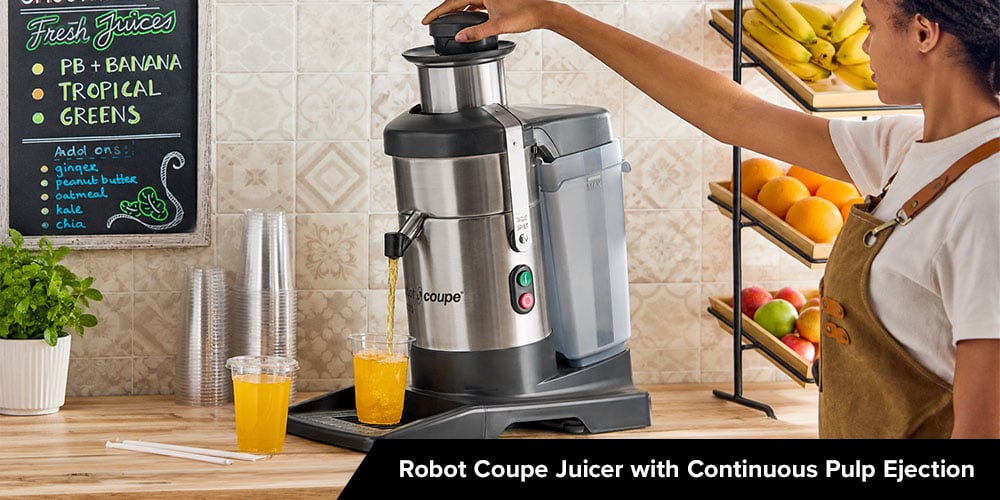
Cafes, smoothie shops, and juice bars that need to keep fresh juice flowing without hovering around the machine will find the Robot Coupe J100 built for exactly that pace. Its 1,000-watt, 1 3/10 hp motor spins at 3,450 RPM, giving it enough speed to extract juice from a steady stream of produce rather than one piece at a time. An auto feed design lets staff keep adding fruit and vegetables without pausing the machine between batches. The spout sits with 10" of clearance underneath, so it pours straight into a blender jar for smoothies or directly into a serving glass, cutting out an extra transfer step during rush service. Pulp can either collect in the included 7.6-qt. container for composting or get ejected straight into a waste bin under the counter, which keeps the workflow moving instead of stopping to empty a basket every few minutes.
Robot Coupe J100 Juicer with Continuous Pulp Ejection - 120 V | $3,094.00
- Auto feed system keeps fruits and vegetables moving through continuously
- Spout clearance of 10" lets it pour directly into a blender jar
- Magnetic safety switch and ventilation system are built in to support extended run times
- Users report that the motor runs loud
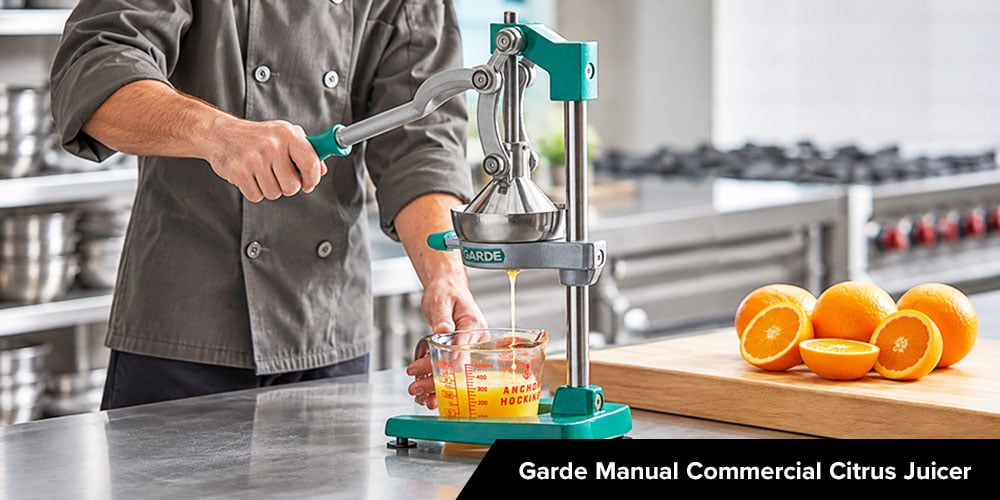
Small cafes, food trucks, and diners that only need fresh citrus juice in small batches don't need to plug in a motor to get it, as a hand press like the Garde MCJ-1 gets the job done without taking up an outlet or counter footprint. Its cast iron and stainless steel build gives it enough durability to survive being pulled down dozens of times a shift, and the 3-pinion lever design pulls extra yield out of each lemon, lime, or orange rather than leaving juice behind. A removable strainer and funnel catch seeds and pulp on the way down, and four suction cup feet keep the whole unit planted on the counter even when someone's putting real weight into the pull. It's a low-cost way to add made-to-order citrus juice to a menu, whether that's fresh-squeezed lemonade, cocktail mixers, or a mimosa station at brunch.
Garde MCJ-1 Heavy-Duty Manual Commercial Citrus Juicer | $139.99
- 3-pinion lever squeezes more juice out of each piece of fruit rather than leaving it in the rind
- No electrical hookup needed
- Rubberized handle grip cuts down on hand fatigue
- Users report that the hardware, particularly the screws, can work loose with repeated use
- Sized for lemons, limes, and standard oranges, so larger grapefruit doesn't fit the reamer as well
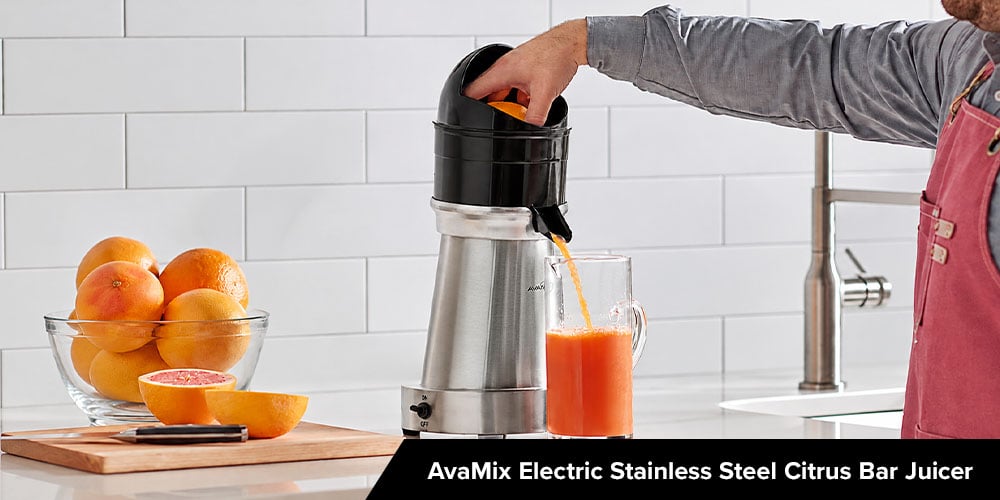
For operators who want to add fresh orange juice or citrus cocktail mixers to the menu without spending thousands on a floor unit, the AvaMix CJ1400 electric stainless steel citrus bar juicer covers the basics at a fraction of the cost. It ships with three interchangeable reamers sized for small, medium, and large citrus, so one machine can handle everything from limes to grapefruit without swapping equipment. A 1,400 RPM motor keeps things quiet enough to run at a bar or coffee counter without drowning out conversation, and the pulp guard and splash guard combo strains the juice while keeping the mess contained to the unit itself. With a spout clearance of nearly 10 inches, it clears most pitchers and glassware, making it a practical fit for cafes, juice bars just getting off the ground, or catering operations that need juicing power on a tighter equipment budget.
AvaMix CJ1400 Electric Stainless Steel Citrus Bar Juicer - 120V, 1,400 RPM | $218.99
Runner up: Galaxy CJ180 Electric Citrus Bar Juicer
- Non-skid feet hold the juicer steady through repeated use
- Three interchangeable reamers cover small, medium, and large citrus without needing a second machine
- Quiet 1,400 RPM motor runs without disrupting conversation at the bar or counter
- 1/4 hp motor is sized only for light-to-moderate citrus volume
How We Chose the Best Commercial Juicers
To simplify the process, we've conducted thorough industry research, gathered customer feedback, and consulted with foodservice experts to compile a list of the top commercial juicers. When selecting a juicer for your establishment, think about how much fruit or produce you're running through it on a given shift and what that finished product needs to look like once it hits a glass. Remember that a coffee shop adding lemonade to the menu has very different needs than a dedicated juice bar pushing through cases of oranges, so what works for one operation might be overkill, or underpowered, for another. Consider your expected volume, available counter space, and how much hands-on labor you're willing to put into each batch. Additionally, think about how the unit handles pulp and waste, and whether it carries the certifications your health department will expect to see.
Speed
Horsepower and RPM work together to determine how much a juicer can push through during a rush, and getting this pairing wrong is one of the most common mistakes operators make when upgrading equipment.
- Horsepower: A stronger motor, generally 3/4 hp or higher, keeps performance steady through dense produce and back-to-back batches without bogging down. Lower horsepower units still get the job done for citrus and lighter-volume service, but they're better suited to intermittent use than nonstop demand.
- RPM: Faster spin speeds extract juice more quickly but tend to run louder and generate more heat, while lower RPM machines operate more quietly and can be gentler on delicate fruit. Matching RPM to your product mix helps avoid burning through motors faster than expected.
Feed Style
The way product enters a juicer shapes the entire pace of service behind the counter:
- Manual Feed: Fruit is loaded and pressed one piece at a time, which suits lower-volume citrus service, food trucks, or bars where juicing isn't the main event.
- Automatic / Continuous Feed: Staff can keep adding fruits or vegetables while the machine runs without stopping to reload, which matters most for juice bars and smoothie counters filling orders back-to-back.
Size
Countertop footprint and overall dimensions determine where a juicer can realistically live in your space. Compact citrus juicers and manual presses take up minimal room and fit tight bar setups, food trucks, or small cafe counters, while continuous feed extractors and floor models need more clearance for their hoppers, waste containers, and motor housings. Spout height is worth checking as well, since a juicer needs enough clearance underneath to accommodate the pitchers, glasses, or blender jars it will actually be filling. Taking accurate measurements before ordering helps avoid ending up with a unit that reads well on a spec sheet but doesn't fit the prep line.
Cleaning Capabilities and Pulp Management
Juicers generate seeds, skins, and pulp fast, so how a unit manages that waste affects both sanitation routines and daily turnaround. Look for tool-free disassembly on baskets, reamers, and strainers too, since being able to pull parts apart by hand at closing saves time.
- Continuous Ejection: Pulp and waste are pushed straight into a bin below the counter as the machine runs, keeping service moving without a pause to empty anything.
- Collection Containers: Pulp gathers in a removable container that needs to be emptied periodically, which works fine for lower-volume operations but adds a step during a rush.
NSF Certification
Certifications are a quick way to confirm a juicer meets food safety and electrical standards before it ever faces a health inspection. An NSF certification signals that food-contact surfaces are designed and built for safe, sanitary use in a commercial setting.
A diner squeezing lemons for iced tea and a juice bar running fresh-pressed orders back-to-back are solving different problems, and the type of juicers that fits one would be wasted money, or a bottleneck, for the other. Weighing motor strength against real order volume, feed style against staffing, and footprint against the actual kitchen or bar layout keeps that decision grounded in how the business runs rather than in a spec sheet. Whatever model ends up on the counter, the aim of your new juicer will be to provide fresh juice on demand with minimal downtime.

With almost a decade of content marketing experience, Kevin has learned the ins and outs of various business sectors. Over his four years as a Longform Content Writer with WebstaurantStore, Kevin has spent hours researching and writing about the intricacies of the foodservice industry. Specializing in marketing guides, technical writing, and structured how-to content, he enjoys providing readers with content that guides them in growing and running their bar or restaurant.
Learn more about this author and WebstaurantStore's Content Writing Team here!
Related Resources

Juice Bar Equipment List
Juice bars have become increasingly popular as people become more health-conscious and seek nutritious alternatives to sugary drinks. Whether you plan on starting a new juice bar or want to expand your existing one, you need different equipment to make and serve delicious and nutritious drinks. This juice bar equipment list outlines the essential equipment and supplies you need to operate your juice bar or smoothie shop ranging from blenders and juicers to cups and straws. Shop All Juice Bar Equipment and Smoothie Supplies Use the following links to learn more about juice bar equipment: Smoothie Equipment Smoothie Ingredients Serveware Cooking Equipment Food Prep Equipment Compartment Sink Refrigeration and Storage Miscellaneous Smoothie Su

Super Juice: A Bartending Hack
Super juice isn't a wellness fad or a green juice recipe; it's a method of extending your fresh citrus juice so that you get more for your money. Usually, citrus peels are tossed out in the trash. With super juice, the peels are combined with the juice to create a sustainable cocktail ingredient. This bartending hack is a cost-effective way to extend your fresh produce while saving time behind the bar. Keep reading to learn more about super juice and how you can make your own. What Is Super Juice? Super juice, also called oleo citrate, is an emulsification of citrus juice, peels, citric acid, malic acid, and water. It may sound scientific, but the result is a great-tasting citrus product that gives you up to 8 times more juice than squeezin

What Is Cold-Pressed Juice?
Unlike traditional juicing methods that use high-speed blades to extract juice, cold-pressed juice is made by pressing and squeezing fruits and vegetables. This gentle extraction process helps to preserve the maximum amount of vitamins, minerals, and enzymes found in the produce. With its numerous health benefits and delicious flavors, it's no wonder that cold-pressed juice has gained popularity among health-conscious individuals and commercial establishments alike. Read on to discover everything you need to know about this trendy type of juice and how your business can integrate it into your menu. Shop All Juice Products Use these links to learn more about cold-pressed juice: What Is a Cold Press? How to Cold Press Juice Is Cold-Pressed Ju
Join Our Mailing List
Receive coupon codes and more right to your inbox.