To fully appreciate and excel in the culinary world, it is essential to understand the vast array of culinary terms and techniques used in professional kitchens. Whether you are a seasoned chef, a culinary student, or a food enthusiast looking to expand your knowledge, having a comprehensive understanding of culinary terminology is crucial. From basic cooking methods to specialized techniques, this glossary will help you navigate the intricate world of culinary arts with confidence and precision.
Use these links to expand your culinary vocabulary and learn new terms:
A-D Culinary Terms
E-I Culinary Terms
J-Q Culinary Terms
R-Z Culinary Terms
A-D Culinary Terms
A
A la carte - A term commonly used in restaurants to describe a menu where each dish is priced separately. This allows customers to order individual items rather than choosing a set meal.
A la mode - A French term that means "in the fashion" or "according to the current style." A dish served a la mode typically refers to a dessert topped with a scoop of ice cream. This combination of warm dessert and ice cream creates a delightful contrast in temperature and texture, making it a popular choice for indulgent treats.
Al dente - An Italian term that translates to "to the tooth," referring to the ideal texture of pasta when it is cooked to be firm but not overdone. Pasta cooked al dente should have a slight resistance when bitten into, offering a satisfying chewiness.
Amuse-Bouche - A single bite-sized appetizer served complimentary by the chef before the meal begins. Unlike an hors d'oeuvre ordered from the menu, an amuse-bouche showcases the kitchen's creativity while introducing guests to the restaurant's flavors, techniques, or seasonal ingredients. Fine dining establishments often use these small courses to set expectations for the dining experience.
Aroma - The smell of food created by volatile compounds released before and during cooking. Aroma plays a major role in flavor perception, making proper ingredient handling, cooking techniques, and food holding practices essential in commercial kitchens. Herbs, spices, roasted meats, baked goods, and caramelized vegetables all develop distinctive aromas that influence the guest experience.
Aspic - A savory jelly made from clarified meat, poultry, seafood, or vegetable stock that naturally contains or is supplemented with gelatin. It is used to coat, suspend, or mold ingredients while preserving moisture and creating an attractive presentation. Although less common in modern foodservice, aspic remains important in classical garde manger and banquet cuisine.
Autolysis - A breadmaking technique that allows flour and water to rest before yeast and salt are added. During this resting period, naturally occurring enzymes begin breaking down proteins and starches, improving gluten development, dough extensibility, and moisture absorption. Commercial bakeries often use autolysis to produce doughs that are easier to handle and develop better texture.
B
Back of House - A term referring to the area in a commercial kitchen where food preparation and cooking take place. The back of house is the heart of any foodservice operation, where chefs and kitchen staff work diligently to create delicious dishes for customers.
Bake - A cooking method that uses dry heat, typically in an oven, to cook food items such as bread, pastries, and casseroles.
Barbecue - A cooking method that slowly cooks food over low, indirect heat while exposing it to wood smoke for flavor. Unlike grilling, barbecue emphasizes long cooking times that gradually tenderize larger cuts of meat such as brisket, pork shoulder, and ribs.
Barding - Practice of wrapping lean cuts of meat with strips of fat, typically bacon or pork fatback, before cooking. The added fat helps reduce moisture loss and adds richness during roasting, especially when preparing naturally lean game meats or poultry.
Baste - The process of moistening food while it is cooking to add flavor, preventing drying out, and enhancing tenderness. This technique involves using a liquid, such as melted butter or pan juices, to continually coat the food during the cooking process.
Batch Cooking - The preparation of food in planned quantities rather than producing an entire day's volume at once. Cooking in smaller batches helps maintain product quality, improve food safety, reduce waste, and ensure fresh food is consistently available throughout service.
Batonnet - A knife cut that produces uniform rectangular sticks measuring approximately 1/4" by 1/4" by 2 to 2 1/2". This classic culinary cut serves as the foundation for smaller cuts like medium dice and is commonly used for vegetables intended for roasting, frying, or serving alongside entrees.
Beat - To vigorously mix ingredients together using a whisk, mixer, or other utensil to incorporate air and create a smooth, uniform texture. This technique is commonly used when making batters, sauces, and desserts in commercial kitchens.
Bechamel - One of the five French mother sauces made by whisking milk into a white roux. The finished sauce has a smooth, creamy consistency and serves as the foundation for numerous sauces, including Mornay.
Beurre Blanc - A classic French butter sauce made by emulsifying cold butter into a reduction of white wine, vinegar, and shallots. The sauce has a rich texture with a delicate balance of acidity and butterfat. It is traditionally paired with seafood, poultry, and vegetables because its smooth consistency complements delicate flavors without overpowering them.
Bisque - Smooth, cream-based soup traditionally prepared from shellfish such as lobster, crab, or shrimp. The shells are roasted and simmered to create an intensely flavored stock before the soup is strained and finished with cream. Modern commercial kitchens may also prepare vegetable bisques using the same velvety consistency.
Bivalves - Mollusks with two hinged shells that protect the edible meat inside. Common foodservice examples include oysters, clams, mussels, and scallops. Because bivalves are filter feeders, restaurants must purchase them from approved suppliers and follow strict temperature controls to meet food safety regulations.
Blanch - Cooking technique that briefly immerses food in boiling water before rapidly cooling it in ice water. This process preserves color, slows enzyme activity, loosens skins, and partially cooks vegetables prior to freezing, sauteing, or further preparation. Commercial kitchens also blanch French fries to improve texture and consistency during final frying.
Boil - A cooking method that involves heating a liquid to its boiling point, where bubbles form and rise to the surface. This technique is used to cook food quickly, soften ingredients, and infuse flavors in soups, sauces, and pasta dishes in commercial kitchens.
Braise - A combination cooking method that begins by searing food at high heat before slowly cooking it in a small amount of liquid inside a covered vessel. The extended cooking time breaks down connective tissue, producing tender meats and richly flavored sauces.
Brassicas - Vegetables belonging to the Brassicaceae family, which includes broccoli, cauliflower, cabbage, Brussels sprouts, kale, and bok choy.
Brigade - A hierarchical kitchen organization that assigns cooks and chefs to specialized stations. Larger restaurants, hotels, and institutional kitchens often organize staff into brigade positions such as executive chef, sous chef, saucier, garde manger, and patissier.
Brine - The process of soaking food in a solution of salt and water to enhance flavor, tenderness, and moisture retention. This technique is commonly used for meats, poultry, and seafood in commercial kitchens to create juicy and flavorful dishes.
Broil - A cooking method that uses direct heat from above to cook food quickly at high temperatures. This technique is ideal for cooking meats, seafood, and vegetables in commercial kitchens, creating a caramelized exterior and juicy interior.
Brunoise - A precise knife cut that creates small cubes measuring approximately 1/8" by 1/8" by 1/8". The cut is produced by first preparing batonnet strips before slicing them into uniform dice.
C
Canapes - Small, decorative appetizers served in one or two bites before a meal or during catered events. They typically consist of a base such as toasted bread or pastry topped with spreads, proteins, cheeses, vegetables, or garnishes.
Caramelize - A cooking technique where sugar is heated until it melts and turns into a golden-brown liquid. Can also refer to the browning of food, adding a rich flavor and color to dishes such as onions, fruits, and meats.
Carryover Cooking - The continued rise in a food's internal temperature after it has been removed from the heat source. Residual heat moves from the exterior toward the center, often increasing the internal temperature by 5 degrees Fahrenheit to 15 degrees Fahrenheit depending on the size of the product.
Cephalopods - Mollusks with tentacles and well-developed nervous systems, including squid, octopus, and cuttlefish. These seafood products are valued for their distinctive texture and versatility in grilling, braising, frying, and sauteing. Proper cooking is essential because cephalopods become tender when cooked either very quickly or over extended periods.
Chafing Dish - A chafing dish is a type of serving dish that uses indirect heat to keep food warm during service. They are commonly used for buffet-style events and are available in various sizes and styles.
Charcuterie - Selection of cured meats, preserved meats, and pates that are typically served on a board with accompaniments like cheeses, fruits, and nuts.
Chiffonade - Knife technique that produces thin ribbons of leafy vegetables or herbs. The leaves are stacked, rolled tightly, and sliced crosswise into uniform strips. Basil, spinach, lettuce, and mint are commonly cut chiffonade for salads, garnishes, soups, and pasta dishes.
Chinois - A fine-mesh conical strainer used to produce exceptionally smooth sauces, soups, stocks, and purees. Its tightly woven mesh removes even the smallest food particles, creating a refined texture that standard strainers cannot achieve.
Chop - Technique used to cut food into small, irregular pieces. This method is commonly used for vegetables, herbs, and nuts and is the first step in many recipes.
Clarified Butter - Butter that has had its water and milk solids removed, leaving nearly pure butterfat. Because the milk solids have been eliminated, clarified butter has a significantly higher smoke point than whole butter, making it well suited for sauteing, frying, and sauce preparation in commercial kitchens.
Coagulate - The process in which proteins change structure and solidify when exposed to heat, acid, enzymes, or mechanical action. This reaction gives cooked eggs, custards, cheeses, and many meat products their characteristic texture. Understanding coagulation helps foodservice operators avoid overcooking delicate protein-based dishes.
Cold Smoking - A preservation and flavoring method that exposes food to smoke while keeping temperatures generally below 90 degrees Fahrenheit. Because the food is not fully cooked during the process, products often require curing before smoking to control microbial growth. The method is commonly used for salmon, cheeses, and bacon.
Comp - Term used in the restaurant industry to refer to providing a complimentary meal to a guest.
Compound Butter - Softened butter blended with herbs, spices, citrus zest, garlic, or other flavoring ingredients. After mixing, it is typically shaped into logs, chilled, and sliced as needed. Restaurants use compound butters to quickly finish steaks, seafood, vegetables, breads, and sauces with consistent flavor.
Conching - A chocolate-making process that continuously mixes, aerates, and refines chocolate to improve its texture and flavor. During conching, unwanted volatile compounds evaporate while cocoa butter becomes more evenly distributed throughout the mixture. The result is smoother chocolate with improved mouthfeel.
Conduction - The transfer of heat through direct contact between food and a hot surface. Many griddles, saute pans, skillets, and flat-top grills cook primarily through conduction. Efficient heat transfer depends on proper cookware selection and consistent contact with the cooking surface.
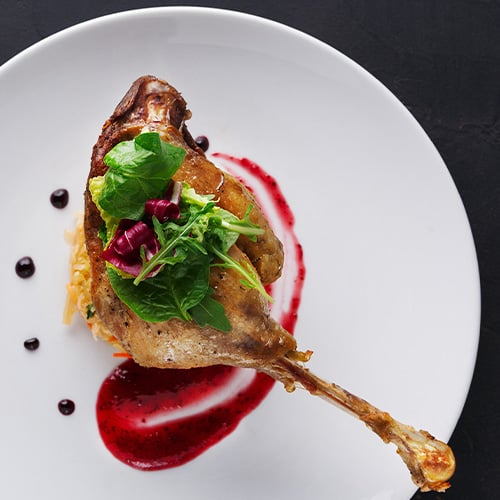
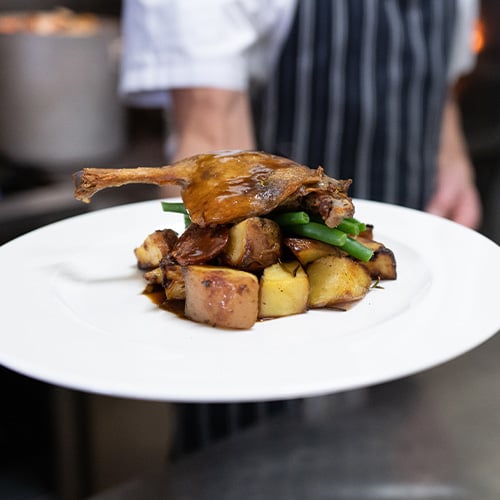
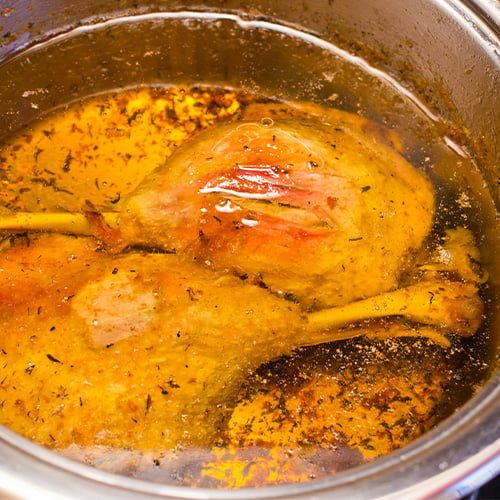
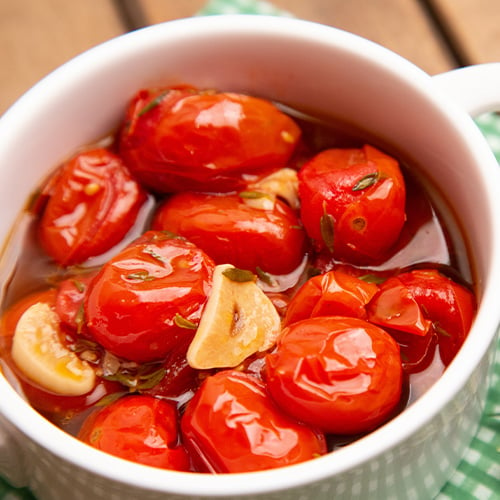
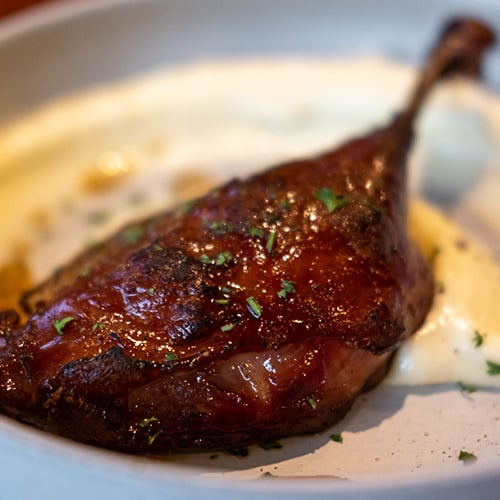
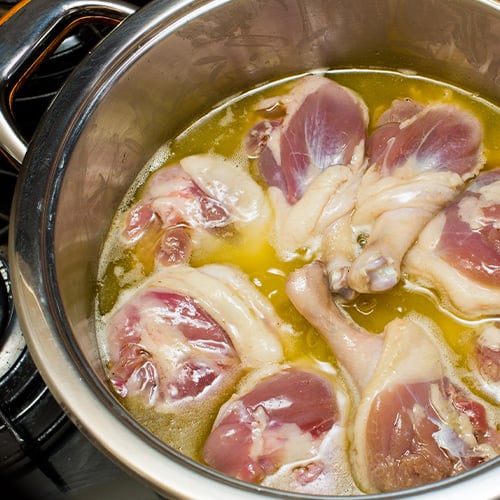
Confit - A cooking method that slowly cooks food while it is submerged in fat at a relatively low temperature. Traditionally associated with duck, confit gently tenderizes meat while helping preserve it after cooking when stored beneath the rendered fat. Modern commercial kitchens also prepare vegetables, garlic, and tomatoes using confit to develop rich flavor and a silky texture.
Consomme - A crystal-clear soup made by clarifying richly flavored stock with a mixture of egg whites and aromatic ingredients. As the mixture simmers, impurities become trapped and are removed, producing a broth with exceptional clarity and concentrated flavor.
Convection - The transfer of heat through the movement of hot air or liquid around food. Commercial convection ovens use fans to circulate heated air, promoting faster cooking, more even browning, and improved consistency compared to conventional ovens.
Core - To remove the central, often inedible, part of the produce. This process is commonly done to apples, pears, and tomatoes.
Coulis - A smooth sauce made by pureeing and straining fruits or vegetables. Fruit coulis commonly accompanies desserts, while vegetable coulis is used to enhance savory dishes with concentrated flavor and vibrant color. Its smooth consistency makes it popular for plating and presentation.
Creaming Method - A baking technique that beats butter and sugar together until the mixture becomes light and aerated. Incorporating air during this step contributes to the volume, tenderness, and texture of cakes, cookies, and quick breads. Commercial bakeries rely on proper creaming times to produce consistent baked goods.
Crustaceans - Shellfish with segmented bodies and hard external shells, including shrimp, lobster, crab, crayfish, and prawns. They are widely used in restaurants because of their versatility in boiling, steaming, grilling, sauteing, and frying. Safe handling and proper cold storage are essential because crustaceans are highly perishable.
Cube - To cut food into small, uniform cubes. This method is often used for ingredients like vegetables, meat, and cheese to ensure even cooking and presentation.
Curing - Process of preserving food by using salt, curing salts, sugar, or other approved ingredients to inhibit microbial growth and improve shelf life. Depending on the product, curing foods may also enhance flavor, texture, and color before smoking, drying, or aging.
Custard - Mixture of milk or cream and eggs that thickens through gentle heat as the proteins coagulate. The finished product may be stirred, baked, or steamed depending on the recipe. Custards are used in desserts such as creme brulee, pastry cream, flan, and ice cream bases.
D
Dash - A small amount of an ingredient, usually 1/8 of a teaspoon, that is added for flavor enhancement. It is a measurement that is less precise than a pinch but still imparts a noticeable taste to a dish.
Deep Fry - Cooking method that fully submerges food in hot oil, typically between 325 degrees Fahrenheit and 375 degrees Fahrenheit. The hot oil rapidly cooks the exterior while creating a crisp crust and sealing in moisture.
Deglaze - The process of adding liquid to a hot pan to dissolve the browned food particles left after searing. These caramelized bits contribute concentrated flavor to sauces, gravies, and braising liquids. Wine, stock, vinegar, or water are most commonly used for deglazing.
Demi-glace - Rich, brown sauce traditionally made by reducing equal parts brown stock and espagnole sauce until thick and intensely flavored. It serves as a base for numerous classic sauces and enhances the flavor of roasted meat dishes.
Depouillage - The continual removal of fat, foam, and impurities from the surface of simmering stocks and sauces. This classical technique improves clarity while producing a cleaner flavor and more refined finished product.
Dim Sum - A style of Chinese cuisine consisting of small, shareable dishes traditionally served with tea. Popular selections include dumplings, buns, rolls, and steamed or fried appetizers prepared in individual portions.
Dressed (Meat) - An animal carcass that has been slaughtered and processed by removing the hide, feathers, internal organs, and other inedible portions. The resulting carcass is ready for chilling, fabrication, or further butchering into wholesale and retail cuts. Dressing standards vary by species and processing requirements.
Drizzle - Culinary technique that involves pouring a thin stream of liquid over food in a controlled manner. This is typically done to add flavor, moisture, or visual appeal to a dish.
Dry Aging - A controlled process that stores large cuts of beef under carefully managed temperature, humidity, and airflow for several weeks. Natural enzymes break down muscle fibers during aging, creating a more tender texture and concentrated beef flavor.
Dry Cooking - Cooking methods that use hot air, radiant heat, or fat instead of water or steam. Roasting, baking, grilling, broiling, sauteing, and frying all fall within this category. These methods often promote browning through the Maillard reaction while developing richer flavors and textures.
Dutch Oven - A heavy-duty cooking pot with thick walls and a tight-fitting lid, usually made of cast iron or enameled cast iron. This versatile cookware is ideal for braising, stewing, roasting, and baking, making it a staple in many commercial kitchens.
Back to Top
E-I Culinary Terms
E
Edible Yield - The usable portion of a food product that remains after trimming, peeling, deboning, or removing waste. Operators use edible yield calculations to determine recipe costs, purchasing requirements, and menu pricing. Higher yields improve profitability by reducing food waste.
Elastin - A connective tissue protein found primarily in ligaments and certain muscles. Unlike collagen, elastin does not break down significantly during cooking, making it naturally tough and difficult to tenderize. Butchers often remove heavy elastin when fabricating premium cuts of meat.
Emulsify - Combining two or more liquids that typically do not mix well together. This technique creates a stable mixture by dispersing one liquid into another with the help of an emulsifier, such as egg yolks or mustard.
En Papillote - A cooking method that seals food inside a parchment paper or foil packet before baking. The enclosed packet traps steam and natural juices, allowing ingredients to cook gently while retaining moisture and flavor. Fish, poultry, and vegetables are commonly prepared en papillote in professional kitchens.
Entrails - The internal organs of an animal, particularly those found within the abdominal cavity. Depending on the cuisine, edible entrails may be prepared as offal, while inedible materials are discarded during processing. Proper handling is critical to prevent contamination during meat fabrication.
Entree - This course is typically served after the appetizer or starter and before the dessert. It is often the focal point of the meal and can feature a variety of proteins, such as meat, poultry, fish, or vegetarian options.
Essence - A highly concentrated liquid that captures the characteristic flavor or aroma of an ingredient. Culinary essences may be produced through extraction, distillation, or reduction and are used in small amounts to enhance foods and beverages. Vanilla essence is one of the most widely recognized examples.
Evaporate - The process by which liquid changes into vapor when heated or exposed to air. In cooking, evaporation concentrates flavors, thickens sauces, and reduces excess moisture from stocks and soups. Controlling the rate of evaporation is essential for achieving consistent recipe results.
Eviscerate - The removal of an animal's internal organs during processing. This step is performed after slaughter to prepare poultry, fish, and livestock for further fabrication while reducing the risk of contamination. Proper evisceration is a critical food safety practice in commercial meat processing.
Expediter - Kitchen professional responsible for coordinating, inspecting, and releasing completed orders during service. Positioned between the kitchen and front-of-house staff, the expediter verifies accuracy, ensures proper plating, and maintains communication so every table receives complete orders at the correct time.
F
Fabrication - Process of breaking down whole food products into smaller, usable portions for cooking or sale. Fabrication commonly includes cutting primal meats into steaks, filleting fish, trimming poultry, or portioning produce. Proper fabrication improves yield, reduces waste, and ensures consistent portion sizes.
Fast Aging - Meat tenderization method that accelerates natural aging through controlled processing techniques rather than traditional extended storage. Commercial processors may use specialized equipment or carefully managed environmental conditions to shorten aging time while improving tenderness. Although it reduces processing time, fast aging generally produces less concentrated flavor than conventional dry aging.
Fat Cap - The layer of exterior fat that remains on certain cuts of meat, such as brisket, pork shoulder, and rib roast. During cooking, the fat gradually renders, helping protect the meat from drying out while contributing flavor and moisture. Many chefs trim the fat cap to a specific thickness to balance rendering with presentation.
Fermentation - Process in which beneficial microorganisms convert sugars into acids, alcohol, or gases. This natural transformation preserves food while developing distinctive flavors and textures in products such as yogurt, kimchi, sauerkraut, sourdough bread, and certain cured meats. Commercial food producers carefully control temperature, time, and sanitation throughout fermentation.
FIFO - An inventory management method that uses older products before newer ones. Rotate inventory by placing newly received ingredients behind existing stock, reducing spoilage and helping maintain food safety.
Filet - A piece of meat or fish that has been deboned and often cut into a boneless, flat shape. A common technique used to prepare proteins for cooking by removing bones and skin.
Flow of Food - Path food follows from purchasing and receiving through storage, preparation, cooking, holding, service, cooling, and reheating. Managing each stage properly helps prevent contamination and foodborne illness while maintaining product quality. Understanding the flow of food is a core principle of commercial food safety programs.
Fold - Technique used in cooking and baking to gently combine ingredients without deflating or overmixing them. This method is often used when incorporating whipped egg whites or delicate ingredients to make dishes like souffles, mousse, and chiffon cakes.
Fondant - A type of icing or frosting commonly used in cake decorating. It is made from sugar, water, and gelatin and has a smooth, pliable texture that can be rolled out and draped over cakes to create a flawless finish.
Food Mill - Manual kitchen tool that purees and strains soft foods using a rotating blade and perforated disc. Unlike a blender, it removes seeds, skins, and fibers while producing a smooth texture without incorporating excessive air.
Foodborne Illness - Disease caused by consuming food contaminated with harmful bacteria, viruses, parasites, toxins, or chemicals. Improper cooking, cross-contamination, poor personal hygiene, and inadequate temperature control are among the leading causes of foodborne illness.
Forcemeat - A seasoned mixture of finely ground meat, fat, and other ingredients used as a filling or base for prepared foods. It is commonly used to produce sausages, pates, terrines, galantines, and stuffed poultry. Proper ratios of lean meat, fat, and binders create the desired texture and consistency.
Front of House - The area where guests are served and interact with staff. This includes the dining room, bar, reception area, and any other spaces where customers receive service.
Frying - Cooking method that uses hot fat or oil to cook food quickly while creating a crisp exterior. Depending on the technique, frying may involve deep frying, shallow frying, pan frying, or stir-frying.
Fumet - Concentrated stock traditionally made by simmering fish bones, shellfish shells, or mushrooms with aromatic vegetables and white wine. Compared to standard stock, fumet is cooked for a shorter period to preserve delicate flavors while producing a more intense finished product. It serves as a flavorful base for seafood soups, sauces, and risottos.
Functional Foods - Foods that provide health benefits beyond their basic nutritional value because they naturally contain or are fortified with beneficial compounds. Examples include probiotic yogurt, omega-3-rich fish, and foods fortified with vitamins or fiber.
Fungi - A biological kingdom that includes mushrooms, truffles, yeasts, and molds. Edible fungi contribute distinctive flavors, textures, and aromas to a wide variety of dishes, while yeast plays a critical role in baking and fermentation.
G
Galantine - Classical preparation made by stuffing a boned poultry or meat product with forcemeat before poaching, chilling, and slicing for service. It is typically served cold and often coated with aspic for presentation. Galantines remain a hallmark of traditional garde manger and banquet cuisine.
Game Meat - Meat harvested from wild animals or specially raised game species rather than conventional livestock. Venison, elk, rabbit, pheasant, quail, and wild boar are common examples. Many game meat varieties are naturally lean, requiring careful cooking techniques to preserve tenderness and moisture.
Garnish - An edible ingredient added to a finished dish to enhance its appearance, flavor, texture, or aroma. Effective garnishes complement the main components rather than serving as decoration alone.
Garde Manger - The kitchen station responsible for preparing and presenting cold foods. Typical responsibilities include salads, charcuterie, pates, terrines, cold appetizers, hors d'oeuvres, and decorative buffet displays. In larger brigade kitchens, the garde manger chef oversees all cold food production.
Gastrique - A reduction built by caramelizing sugar and then deglazing it with vinegar, wine, or citrus juice, simmered down into a glossy, tangy syrup.
Gelatin - A protein derived from animal collagen that forms a gel when dissolved in liquid and cooled. It is widely used to thicken, stabilize, and set desserts, aspics, mousses, and certain sauces.
Glace - Highly concentrated reduction of stock that is cooked until it reaches a syrup-like consistency. Because much of the water has evaporated, glace delivers an intense flavor and is often used in small amounts to enrich sauces, soups, and braised dishes.
Glaze - A liquid mixture applied to food to add flavor, moisture, and a glossy finish. Glazes are often made from ingredients like sugar, honey, vinegar, or fruit juices.
Gluten - Network of proteins naturally found in wheat, barley, and rye. When flour is mixed with water and worked into dough, gluten develops elasticity and structure that allow bread and other baked goods to rise and maintain their shape.
GMO - Short for "genetically modified organism", referring to a plant, animal, or microorganism whose DNA has been altered using genetic engineering techniques. In the food industry, genetically modified crops may be developed for improved pest resistance, herbicide tolerance, or higher yields. GMO labeling requirements vary by country and regulatory authority.
Grate - To shred into small pieces using a grater, a kitchen tool with sharp-edged holes. Grated ingredients like cheese, vegetables, and citrus zest are commonly used in various dishes to add texture and flavor.
Grease - Fats or oils used for cooking or lubricating cooking surfaces. Grease is often used to prevent food from sticking to pans or grills and to add flavor and moisture to dishes.
Griddle - A flat cooking surface typically made of metal or stone that is heated from below. Griddles are versatile tools in commercial kitchens and are used to cook foods like pancakes, eggs, burgers, and sandwiches.
Grill - A cooking surface with metal bars or ridges where food is placed directly over heat. Grilling imparts a distinct charred flavor to food and is commonly used for cooking meats, vegetables, and seafood.
H
HACCP - A Hazard Analysis and Critical Control Points plan, is a preventive food safety system that identifies, evaluates, and controls hazards throughout food production. Rather than relying solely on finished product inspections, an HACCP plan establishes critical control points where biological, chemical, and physical risks can be monitored and corrected.
Halal - Refers to foods and beverages that comply with Islamic dietary laws. For meat to be considered halal, it must come from permitted animals that are processed according to specific religious requirements. Many commercial foodservice operations offer halal-certified menu items to accommodate customer preferences and dietary needs.
Hash - Dish made by combining diced or chopped meat with potatoes and other ingredients before browning them together in a skillet or on a griddle. Leftover roasted or cooked meats are commonly used, making hash an efficient way to reduce food waste. Variations may include onions, peppers, herbs, or eggs.
Hollandaise - One of the five French mother sauces made by emulsifying clarified butter into egg yolks with an acidic ingredient such as lemon juice or vinegar. The finished sauce is rich, smooth, and lightly tangy. Hollandaise is traditionally served with eggs Benedict, asparagus, seafood, and other vegetables.
Homogenization - A mechanical process that forces milk through tiny openings under high pressure to evenly disperse fat throughout the liquid. This prevents cream from separating during storage while creating a smoother, more uniform texture. Most fluid milk sold for commercial foodservice is homogenized.
Hors D'Oeuvre - Small, bite-sized food items served before a meal to stimulate the appetite. These appetizers can be hot or cold and are often served on platters or passed around at events.
Hot Smoking - Cooking process that exposes food to smoke while maintaining temperatures high enough to fully cook the product. Unlike cold smoking, hot smoking both cooks and flavors food at the same time.
Hygiene - The practices and protocols followed to ensure the cleanliness and safety of food preparation areas, equipment, and personnel. Maintaining high standards of hygiene is crucial to prevent foodborne illnesses and ensure the quality of food products.
Hydrogenation - Food processing method that adds hydrogen to unsaturated oils, converting them into more solid and stable fats. Partial hydrogenation produces trans fats, which have been largely eliminated from commercial food production because of health concerns. Fully hydrogenated oils do not contain trans fats and may still be used in certain food applications.
I
Infrared Cooking - Uses radiant infrared energy to transfer heat directly to the surface of food. Because the energy heats the product instead of the surrounding air, infrared equipment reaches cooking temperatures quickly and produces efficient browning.
In the Weeds - Kitchen slang term used to describe a situation where a chef or kitchen staff member is overwhelmed with a high volume of orders or tasks, leading to a state of being behind schedule or feeling stressed.
IQF - IQF, or Individually Quick Frozen, is a freezing process that rapidly freezes individual food pieces so they remain separate instead of clumping together. Fruits, vegetables, seafood, poultry, and prepared ingredients commonly undergo IQF processing to preserve texture and simplify portioning. Foodservice operators benefit from reduced waste and greater inventory flexibility.
Induction - A cooking method that uses electromagnetic energy to heat cookware directly, rather than relying on a traditional gas flame or electric heating element. This technology allows for precise control over temperature and is known for its efficiency and speed in commercial kitchens.
Infusion - A culinary technique that involves steeping ingredients such as herbs, spices, fruits, or vegetables in a liquid (such as water, oil, or alcohol) to extract their flavors. This process allows the liquid to take on the essence of the infused ingredients, adding depth and complexity to dishes or beverages.
Back to Top
J-Q Culinary Terms
J
Jambalaya - A traditional Creole and Cajun dish from Louisiana that typically consists of a mixture of rice, meat, and vegetables.
Jugging - Traditional cooking method in which meat, most commonly game, is slowly braised in a tightly sealed container with stock, wine, and aromatic ingredients. The enclosed vessel traps moisture while allowing connective tissue to break down gradually during cooking.
Julienne - A culinary term that refers to cutting fruits, vegetables, or meats into long, thin strips. This knife-cutting technique is commonly used in food preparation to create uniform pieces for cooking or garnishing dishes.
Jus - Light, naturally flavored sauce made from the juices released by meat during roasting or braising. Unlike gravy, jus is typically not thickened with flour or starch, resulting in a thinner consistency that highlights the meat's natural flavor. Restaurants commonly serve jus with roasted beef, pork, lamb, and poultry.
K
Knead - A fundamental technique in baking that refers to the process of working dough with the hands to develop gluten. This action helps create structure and elasticity in the dough, resulting in a lighter and more uniform texture in the final baked product.
Kosher - Food products that adhere to Jewish dietary laws. These laws dictate what foods can and cannot be consumed and how they must be prepared. Foods that are labeled as kosher have been prepared in accordance with these guidelines and have been certified by a kosher certification agency.
L
Lamination - Pastry technique that creates alternating layers of dough and butter through repeated rolling and folding. As the butter releases steam during baking, the layers separate to produce a light, flaky texture.
Lard - A type of fat that is rendered from pig fat. Lard has a high smoke point, making it ideal for frying and sauteing.
Leach - Process by which water removes soluble substances from food during soaking or cooking. This may reduce bitterness, excess salt, starch, or naturally occurring compounds depending on the ingredient. Commercial kitchens commonly leach potatoes before frying and certain vegetables before cooking.
Leaven - A substance that causes dough to rise and become light and airy. Common leavening agents include yeast, baking powder, and baking soda
Legume - A type of plant in the pea family that includes beans, lentils, and peas. Legumes are commonly used in soups, stews, salads, and side dishes.
M
Macedoine - A classical knife cut consisting of uniform cubes measuring approximately 1/4" by 1/4" by 1/4". The cut is commonly used for cooked or raw vegetables in soups, salads, and garnishes where consistent size promotes even cooking and an attractive presentation. In classical cuisine, the term may also refer to a mixed vegetable preparation made with this cut.
Maillard Reaction - Chemical reaction between amino acids and reducing sugars that creates the browned color and complex flavors found in cooked foods. It occurs most effectively at temperatures above approximately 285 degrees Fahrenheit under relatively dry conditions. Grilling, roasting, searing, and baking all rely on the Maillard reaction to develop flavor and appearance.
Marbling - The network of intramuscular fat distributed throughout a cut of meat. As the meat cooks, this fat melts and contributes to tenderness, juiciness, and flavor. Beef grading systems place significant emphasis on marbling because it is a strong indicator of eating quality.
Marinate - To soak food in a seasoned liquid mixture to enhance its flavor or tenderize it. Marinating is a common technique used in commercial kitchens to infuse proteins such as meat, poultry, or seafood with additional taste.
Mignonette - A classic French sauce that is commonly served with oysters. This tangy and flavorful sauce is typically made with a combination of minced shallots, cracked black pepper, and vinegar, often using red wine vinegar or champagne vinegar for a unique taste.
Mincing - A knife technique that cuts food into very small, finely chopped pieces. Garlic, onions, herbs, and ginger are frequently minced to distribute flavor evenly throughout a dish without creating large, noticeable pieces. Uniform mincing also promotes consistent cooking.
Mirepoix - Mixture of diced onions, carrots, and celery used as the flavor base for stocks, soups, sauces, and braised dishes. Commercial kitchens prepare mirepoix in large batches because it serves as the foundation for numerous recipes.
Mollusks - Group of invertebrate animals that includes bivalves, cephalopods, and univalves. Oysters, clams, mussels, squid, octopus, snails, and abalone are all examples of edible mollusks. Proper handling, storage, and cooking are essential because many mollusks are highly perishable.
Mornay Sauce - Classic cheese sauce made by adding grated cheese, traditionally Gruyere or Parmesan, to bechamel sauce. The result is a smooth, creamy sauce commonly used in gratins, baked pasta dishes, vegetables, and seafood preparations. It is one of the best-known derivative sauces of bechamel.
Mother Sauce - Mother sauces are the foundation of classical French cuisine, serving as the base for a variety of derivative sauces. There are five primary mother sauces: bechamel, veloute, espagnole, tomato, and hollandaise.
Mousse - Light, airy preparation created by folding whipped cream, whipped egg whites, or both into a flavored base. Sweet mousses often feature chocolate or fruit, while savory versions may incorporate seafood, poultry, or vegetables. Commercial kitchens value mousse for its smooth texture and elegant presentation.
MSG - MSG, or monosodium glutamate, is a flavor enhancer that intensifies the savory taste known as umami. It occurs naturally in foods such as tomatoes, mushrooms, and aged cheeses and is also produced commercially for culinary use. Restaurants and food manufacturers use MSG to enhance flavor without significantly increasing sodium content.
Mushrooms - Edible fungi prized for their earthy flavor, meaty texture, and culinary versatility. Common foodservice varities include button, cremini, shiitake, oyster, portobello, and enoki mushrooms. They are widely used in soups, sauces, pizzas, stir-fries, and meatless menu items.
Mycoprotein - Protein-rich food ingredient produced through the fermentation of a naturally occurring fungus. It has a fibrous texture that closely resembles meat, making it a popular ingredient in vegetarian and vegan products. Commercial food manufacturers use mycoprotein in meat alternatives such as cutlets, nuggets, and ground-style products.
N
Nigiri - A classic Japanese dish similar to sashimi that consists of a small ball of vinegared sushi rice topped with a slice of raw fish or seafood. The word "nigiri" translates to "two fingers" in Japanese, referring to the way the rice is shaped by hand.
Nappe - A French culinary term describing the moment a liquid thickens enough to coat the back of a spoon in a smooth, even layer rather than sliding off in thin streaks. Cooks check for nappe by drawing a finger through the coating on the spoon. If the line stays clean and doesn't flood back together, the mixture has hit the right stage for service or storage.
O
Organic - Food produced according to agricultural standards that limit the use of synthetic pesticides, fertilizers, genetically modified organisms, and certain other production methods. In the United States, products labeled as organic must meet standards established by the USDA National Organic Program. Many foodservice operators offer organic ingredients to satisfy customer demand for certified agricultural products.
Orzo - A small, rice-shaped pasta that is commonly used in a variety of culinary dishes. Despite its appearance, orzo is made from wheat flour, making it a type of pasta rather than a grain.
OSHA - OSHA, or the Occupational Safety and Health Administration, is the federal agency responsible for enforcing workplace safety and health regulations in the United States. Commercial kitchens are required to follow OSHA standards to reduce hazards related to equipment, chemicals, slips, falls, electrical systems, and employee training. Compliance helps create a safer work environment while reducing the risk of workplace injuries.
Overhead Costs - Ongoing business expenses required to operate a foodservice establishment that are not directly tied to producing individual menu items. Examples include rent, utilities, insurance, equipment maintenance, administrative salaries, and property taxes. Understanding overhead costs is essential when setting menu prices and evaluating profitability.
P
Pan Fry - A cooking method that uses a shallow layer of hot oil to cook food in a skillet or saute pan. Unlike deep frying, the food is only partially submerged and is typically turned during cooking to brown both sides evenly.
Pan Smoking - Cooking technique that generates smoke inside a covered pan by heating wood chips, tea leaves, herbs, rice, or similar ingredients beneath a rack holding the food. The enclosed environment lightly infuses the product with smoky flavor while partially or fully cooking it. Restaurants often use pan smoking when dedicated smokers are unavailable.
Parmentier - Dishes prepared with or featuring potatoes, named after French agronomist Antoine-Augustin Parmentier, who promoted potato consumption in France.
Parboil - Cooking technique where food items are partially cooked in boiling water or broth. This process helps reduce cooking time for items like potatoes or vegetables that normally have to be cooked for a long time.
Parstock - Minimum quantity of an inventory item that should be kept on hand to support normal foodservice operations. Operators establish par levels based on menu demand, delivery schedules, storage capacity, and usage rates. Monitoring parstock helps prevent shortages while avoiding unnecessary overstocking.
Pasteurization - Heat treatment process that eliminates harmful bacteria from food and beverages, ensuring safety and extending shelf life. Commonly used for dairy products and juices, pasteurization helps maintain product quality and freshness.
Pate - Smooth and creamy mixture of seasoned ground meat, poultry, or seafood. This versatile dish can be served as a spread, appetizer, or filling for pastries, adding a rich and savory flavor to various dishes.
Paysanne - Knife cut that produces thin, flat pieces of vegetables in shapes that match the vegetable's natural form, such as squares, circles, or triangles. The slices are typically about 1/2 inch wide and 1/8 inch thick. This cut is commonly used in soups, stews, and vegetable medleys where quick, even cooking is desired.
Peel - The process of removing the outer skin or rind from fruits and vegetables before cooking or consuming them. This step helps improve the appearance, texture, and flavor of the produce, making it more appealing and easier to eat.
Pickling - Preservation method that uses vinegar or controlled fermentation with salt to extend the shelf life of food. In addition to preserving ingredients, pickling creates distinctive acidic flavors and crisp textures. Cucumbers, onions, peppers, eggs, and numerous vegetables are commonly pickled in commercial kitchens.
Pinch - Informal unit of measurement referring to the small amount of a dry ingredient, typically a spice, herb, or salt, that can be held between the thumb and first two fingers, generally equal to about 1/16 of a teaspoon.
Pipe - Technique used in pastry and cake decorating where a mixture like frosting or dough is placed in a piping bag and squeezed through a nozzle or piping tip to create decorative designs. This method allows for precise and intricate decorations on baked goods.
Pith - Soft, white, spongy layer found beneath the outer peel of citrus fruits. While edible, it contains compounds that often produce a bitter flavor, so many recipes remove it before preparation.
Plating - Process of arranging and presenting food on a serving plate before it reaches the guest. Effective plating emphasizes balance, portion consistency, color contrast, and ease of eating while reflecting the restaurant's style. Standardized plating procedures help maintain consistency throughout service.
Poach - Gently cooking food in a simmering liquid such as water, broth, or wine. This method is commonly used for delicate foods like eggs, fish, or fruits, resulting in a tender and flavorful end product.
Portion Control - Practice of serving consistent quantities of food according to established recipe and menu specifications. Maintaining accurate portions improves food cost management, reduces waste, and ensures guests receive consistent value with every order.
Preserving - Process of extending the shelf life of food by slowing spoilage and microbial growth. Common preservation methods include canning, freezing, drying, curing, fermenting, smoking, and pickling.
Pressure Cooking - Mist-heat cooking method that prepares food inside a sealed vessel under elevated pressure. The increased pressure raises the boiling point of water, allowing food to cook faster while retaining moisture. Commercial pressure cookers are commonly used for stocks, legumes, braised meats, and certain vegetables.
Primal Cut - One of the large primary sections into which an animal carcass is initially divided during fabrication. Beef primals include the chuck, rib, loin, round, brisket, plate, flank, and shank, while other species have their own primal classifications. Butchers further process primal cuts into subprimal and retail cuts.
Prix Fixe - Menu format that offers a predetermined selection of courses for one set price. Guests typically choose from a limited number of options within each course while paying a single fixed cost for the meal. Restaurants often use prix fixe for special events, holidays, tasting menus, and fine dining service.
Proofing - The final rise of yeast-leavened dough before baking. During this stage, yeast produces carbon dioxide that expands the dough, improving volume, texture, and crumb structure. Commercial bakeries carefully control proofing temperature and humidity to ensure consistent results.
Processing - Transformation of raw agricultural products into ingredients or finished foods through physical, chemical, or biological methods. Processing may include washing, cutting, cooking, freezing, fermenting, packaging, or preserving. Commercial food processors use these techniques to improve safety, shelf life, consistency, and convenience.
Puree - Blending or processing cooked or raw foods into a smooth and uniform consistency. This technique is commonly used for soups, sauces, baby food, and desserts, creating silky textures and concentrated flavors.
Q
Quality Control - Systematic process of monitoring food products and preparation procedures to ensure they consistently meet established standards. Commercial foodservice operations evaluate factors such as taste, appearance, texture, temperature, portion size, and food safety throughout production.
Quenelle - An oval-shaped portion of soft food formed using two spoons or a specialized utensil. Ice cream, mashed potatoes, mousses, sorbets, and forcemeats are commonly shaped into quenelles for an elegant presentation. The smooth, symmetrical shape is a hallmark of classical culinary technique.
Quick-Service Restaurant (QSR) - Also known as fast-food restaurants, quick-service restaurants are a type of restaurant that offer expedited and convenient food options to customers. These restaurants typically have a limited menu, focus on speed of service, and often feature self-service options for ordering and payment.
Back to Top
R-Z Culinary Terms
R
Ragu - A slow-cooked Italian meat sauce made by simmering ground or chopped meat with vegetables, wine, stock, and tomatoes or tomato paste, depending on the regional variation. Extended cooking develops a rich, concentrated flavor and tender texture. Ragu is traditionally served with pasta, polenta, or layered baked dishes.
Ramen - Japanese noodle dish consisting of wheat noodles served in a seasoned broth with various proteins and garnishes. Common broth styles include shoyu, miso, shio, and tonkotsu, each offering distinct flavor profiles. Commercial restaurants often customize ramen with toppings such as chashu pork, eggs, seaweed, and scallions.
Recipe Costing - Process of calculating the total ingredient cost of a recipe and determining its cost per serving. Foodservice operators use recipe costing to establish profitable menu prices, control food costs, and evaluate recipe performance. Accurate costing depends on current ingredient prices, edible yield, and standardized portions.
Reduction - Liquid that has been concentrated by simmering to evaporate water. As moisture decreases, flavors intensify and the liquid naturally thickens. Reductions form the foundation of many sauces, glazes, soups, and braising liquids.
Remouillage - A secondary stock made by simmering bones that have already been used to prepare a primary stock. Although lighter in flavor and body, remouillage can be used in soups, sauces, or as the base for another stock. Classical kitchens often prepare remouillage to maximize ingredient utilization.
Requisition - A formal request for ingredients, supplies, or equipment issued from one department to another within a foodservice operation. Kitchens commonly submit requisitions to purchasing departments or storerooms to replenish inventory. Maintaining accurate requisition records supports inventory control and cost management.
Rillette - Spreadable preparation made by slowly cooking meat in its own fat until tender, then shredding and mixing it with rendered fat. Pork is the traditional choice, although duck, rabbit, salmon, and other proteins are also used. Rillettes are commonly served chilled with bread, crackers, and pickled accompaniments.
Risotto Method - Cooking technique that gradually incorporates hot stock into short-grain rice while stirring frequently. Adding the liquid in stages allows the rice to release starch, creating the creamy texture characteristic of risotto without making the grains mushy. Arborio, Carnaroli, and Vialone Nano are the varieties most commonly used.
Roast - A dry-heat cooking method that involves cooking food in an oven or over an open flame. This technique is commonly used for meats, poultry, vegetables, and even nuts to enhance their flavors through caramelization and Maillard reactions.
Rondelle - Knife cut that produces round, coin-shaped slices from cylindrical vegetables such as carrots, cucumbers, zucchini, and bananas. The thickness of the slices varies according to the recipe and intended use. Rondelles are commonly used in salads, soups, stir-fries, and garnishes.
Root Vegetables - Edible underground plant structures that store nutrients for growth. Potatoes, carrots, beets, parsnips, turnips, radishes, and rutabagas are common examples of root vegetables used in commercial kitchens. They are valued for their versatility, long storage life, and suitability for roasting, steaming, frying, boiling, and pureeing.
Roulade - Dish made by rolling a flattened piece of meat, poultry, fish, sponge cake, or pastry around a filling before cooking or baking. Savory roulades often contain vegetables, cheeses, herbs, or forcemeat, while sweet versions may be filled with cream, fruit, or chocolate. After cooking, the roulade is sliced to showcase its spiral presentation.
Roux - Thickening agent for sauces, soups, and stews. It is a mixture of equal parts flour and fat, traditionally butter, cooked together to form a smooth paste.
S
Salaison - Process of preserving food, particularly meat or fish, by treating it with salt. The salt draws out moisture and helps create conditions that inhibit microbial growth while developing the characteristic flavor and texture of cured products.
Saucier - Member of a classical French kitchen brigade responsible for preparing sauces, gravies, and often sauteed dishes. The position requires strong knowledge of stocks, reductions, emulsions, and mother sauces because sauces frequently finish or accompany other menu items. In larger commercial kitchens, the saucier works closely with the chef and other stations to coordinate finished dishes.
Saute - Cooking method that involves quickly cooking food in a small amount of oil or fat over high heat. This technique is commonly used to cook vegetables, meats, and seafood, resulting in a caramelized exterior and a tender interior.
Sauteuse - Wide, relatively deep cooking pan with sloped or curved sides designed for sauteing, braising, and other stovetop preparations. Its shape provides more capacity than a traditional skillet while still allowing cooks to toss or turn food easily. Commercial kitchens use sauteuses for preparing meats, poultry, vegetables, and sauces in larger quantities.
Sautoir - Broad, heavy-bottomed cooking pan with straight sides and typically two handles. Its flat surface and relatively deep sides make it useful for sauteing, searing, braising, and reducing sauces. The sturdy construction also promotes even heat distribution during high-volume cooking.
Scald - Process of heating a liquid, such as milk or cream, to just below the boiling point. This technique is used to kill bacteria, dissolve ingredients, or prepare liquids for further cooking or baking.
Scale - Measuring device that determines the weight of ingredients or finished food products. Kitchens use commercial scales to portion proteins, measure recipe ingredients, control yields, and maintain consistent serving sizes. Weighing ingredients is particularly important for recipe costing because purchasing and food costs are generally calculated by weight.
Score -The practice of making shallow cuts or slashes on the surface of food, such as meat or bread, before cooking. This technique helps the food cook evenly, allows marinades to penetrate, and creates a decorative presentation.
Sear - Cooking technique that involves quickly cooking meat or seafood over high heat to caramelize the surface and lock in juices. This method is often used to add flavor and create a crispy exterior on proteins.
Shallow-Frying - Cooking method in which food is partially submerged in a relatively small amount of hot oil or fat. The food is typically turned during cooking so both sides develop a browned, crisp exterior.
Shortening - Solid or semi-solid fat used primarily in baking and frying to create tenderness, texture, or stability. Vegetable shortening contains little or no water, allowing it to produce flaky pastry and tender baked goods while also performing well in certain frying applications.
Shred - Act of cutting food into long, thin strips or pieces. This technique is commonly used with vegetables, cheeses, and proteins to create texture, enhance presentation, and facilitate even cooking.
Shucked - Shellfish that has been removed from its shell. Oysters, clams, and scallops may be purchased shucked for use in restaurants, reducing preparation time and labor compared with processing whole shell-on products. Shucked seafood is highly perishable and requires appropriate refrigerated storage and handling.
Simmering - Moist-heat cooking method that keeps liquid just below a full boil, generally around 185 degrees Fahrenheit to 205 degrees Fahrenheit at sea level. The gentle movement of the liquid cooks food more slowly than boiling while helping prevent delicate ingredients from breaking apart.
Slurry - Mixture of a starch and cold liquid used to thicken hot foods. Cornstarch and water are commonly combined into a slurry before being whisked into soups, sauces, gravies, and stir-fry preparations. Mixing the starch with cold liquid first helps prevent clumping when it is added to hot liquid.
Smoke Point - The temperature at which a cooking fat or oil begins producing visible smoke as it breaks down. Selecting an oil with an appropriate smoke point helps prevent undesirable flavors and excessive degradation during high-temperature cooking. Commercial fryers and saute stations require fats that can withstand the temperatures associated with their cooking methods.
Soubise - Classic French sauce made primarily from onions that are slowly cooked until tender and then combined with bechamel or cream. The onions are cooked gently enough to develop sweetness without excessive browning, producing a smooth, mild sauce.
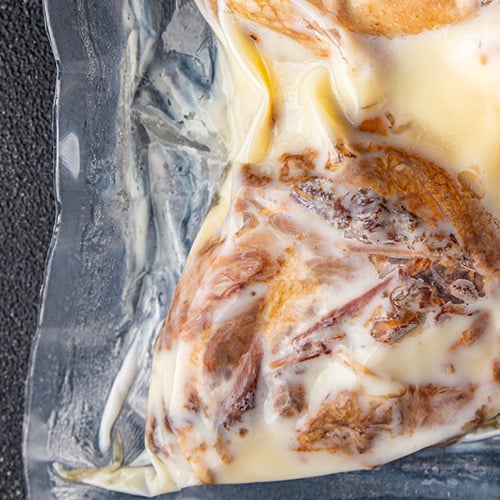
Sous Vide - Cooking method that seals food in an airtight bag and cooks it in a precisely controlled water bath at a specific temperature. The technique provides exceptionally consistent doneness because the food does not exceed the temperature of the surrounding water bath. Commercial kitchens use sous vide for proteins, vegetables, eggs, and other foods, often followed by a high-heat sear for browning.
Standard Breading Procedure - A three-step method of coating food with flour, an egg or liquid wash, and breadcrumbs before cooking. The flour helps the wash adhere, while the final breading creates a crisp exterior during frying or baking.
Starch - A complex carbohydrate found in plants that serves as an important source of energy and a functional ingredient in cooking. Foods such as potatoes, corn, rice, wheat, and legumes contain substantial amounts of starch, which can gelatinize when heated with water and thicken liquids. Commercial kitchens use starches such as cornstarch, flour, and potato starch to thicken sauces and modify the texture of foods.
Steaming - A moist-heat cooking method that cooks food with hot water vapor rather than immersing it directly in liquid. Commercial steamers allow operators to cook large quantities of vegetables, seafood, grains, dumplings, and other foods while limiting direct contact with water. Proper steaming can help preserve delicate textures, colors, and nutrients.
Steep - The process of soaking an ingredient, such as tea leaves or herbs, in a liquid to extract flavor. This technique is often used in preparing beverages like tea or infusing flavors into broths and sauces.
Stewing - Moist-heat cooking method that slowly cooks small pieces of food in enough liquid to partially or completely cover them. The extended cooking time breaks down connective tissue and develops concentrated flavors in the cooking liquid. Tough cuts of meat, poultry, legumes, and root vegetables are particularly well suited to stewing.
Stir-Frying - High-heat cooking method that rapidly cooks small, uniformly cut ingredients in a small amount of oil while they are continuously stirred or tossed. The technique is traditionally associated with Chinese cuisine and is commonly performed in a wok.
Stock - Flavorful liquid made by simmering bones, meat, seafood, vegetables, and aromatic ingredients in water. Collagen extracted from bones can contribute body and gelatin to the finished liquid, while vegetables and aromatics provide flavor. Commercial kitchens use stocks as foundations for soups, sauces, gravies, braises, and other preparations.
Strain - Process of separating solid particles from a liquid by passing the mixture through a sieve, strainer, chinois, or similar filtration tool. Commercial kitchens strain stocks, sauces, soups, purees, and beverages to achieve the desired clarity and texture. The fineness of the strainer determines how much particulate matter remains in the finished product.
Subprimal Cut - A smaller section of meat produced by further dividing a primal cut during fabrication. Beef subprimals include the tenderloin, strip loin, and ribeye roll, which can then be portioned into individual steaks or other cuts. Purchasing subprimals can reduce fabrication labor while providing greater control over portioning and yield.
Suet - Firm fat found around the kidneys and other internal organs of cattle and sheep. Because of its high melting point and distinctive texture, suet is traditionally used in pastries, puddings, forcemeats, and rendered cooking fats. Commercial kitchens may use rendered suet or processed forms when a recipe specifically calls for its properties.
Sushi - Japanese preparation centered on vinegared rice that is combined with ingredients such as seafood, vegetables, egg, or other toppings and fillings. Common forms include nigiri, maki, temaki, and uramaki. Commercial sushi operations require strict temperature control, sanitation, and sourcing practices, particularly when serving raw seafood..
Sweat - Gently cooking vegetables in a covered pan with a small amount of fat over low heat. This process helps release the natural juices of the vegetables, resulting in a soft and translucent texture.
T
Tapas - Small Spanish dishes served individually or shared as part of a meal. They may include hot or cold preparations ranging from olives and cured meats to croquettes, grilled seafood, and cooked vegetables. Restaurants often use tapas-style menu to offer guests a broad selection of dishes while controlling individual portion sizes.
Tapenade - Thick Mediterranean spread traditionally made from finely chopped or pureed olives, capers, and anchovies, with olive oil and other seasonings commonly added. It is served as a spread, condiment, garnish, or component of appetizers and entrees. Commercial kitchens can use tapenade to add concentrated salty, briny flavor to sandwiches, seafood, meats, and vegetables.
TDZ - TDZ, or temperature danger zone, refers to the temperature range in which potentially hazardous food is particularly susceptible to rapid pathogen growth. The FDA identifies the range as 41 degrees Fahrenheit to 135 degrees Fahrenheit for retail food safety purposes. Commercial foodservice operators minimize the time TCS foods spend in this range through proper cooking, holding, cooling, reheating, and refrigeration procedures.
Temper - The process of slowly raising the temperature of one ingredient by incorporating small amounts of a hot liquid or mixture. This technique is commonly used in recipes that involve adding hot liquids.
Terrine - Preparation of meat, poultry, seafood, vegetables, or other ingredients that is cooked and served in a loaf-shaped mold called a terrine. Traditional terrines are often chilled before slicing and may contain forcemeat, aspic, or layers of different ingredients. They are a classic component of garde manger and are well suited to banquet and cold-food service.
Toast - Process of browning or crisping food items using dry heat. Toasting can enhance the flavor and texture of various ingredients, such as nuts, bread, spices, or grains.
Tourne - Classical knife cut that shapes vegetables into small, seven-sided football-like pieces with tapered ends. A traditional tourne is approximately 2" long and is created using a paring knife. Potatoes, carrots, turnips, and other firm vegetables may be tourneed for refined presentations and even cooking.
U
Ultrapasteurization - Heat treatment that processes milk or milk products at or above 280 degrees Fahrenheit for at least 2 seconds to produce an extended refrigerated shelf life. The process uses substantially higher temperatures than conventional pasteurization while stopping short of commercial sterilization. Foodservice operators may use ultrapasteurized dairy products when longer refrigerated shelf life is beneficial.
Umami - One of the five basic tastes alongside sweet, sour, bitter, and salty. Foods rich in umami flavor often have a savory or meaty taste that enhances the overall complexity of a dish.
Univalves - Mollusks with a single shell, unlike bivalves, which have two hinged shells. Edible univalves include snails, abalone, conch, and whelks. These shellfish are used in a range of cuisines and may be prepared by sauteing, baking, braising, steaming, or incorporating them into soups and sauces.
Unleavened - Bread or dough that does not contain a leavening agent, such as yeast or baking powder. Unleavened bread is commonly used in various culinary applications, including certain types of flatbreads, crackers, and tortillas.
V
Vacuum-Packed - Vacuum-packed food has been sealed in packaging from which most of the air has been removed before the package is closed. Removing air can reduce oxidation and help preserve product quality, while also making foods more compact for storage and transportation. Vacuum packaging does not eliminate the need for proper refrigeration or food safety controls.
Veloute - One of the five French mother sauces made by thickening a light stock with a blond roux. Chicken, veal, or fish stock may be used depending on the finished sauce, which is generally smooth and relatively light in color. Veloute also serves as the foundation for several derivative sauces used with poultry, seafood, and other dishes.
Vinegar - Acidic liquid produced when alcohol undergoes fermentation by acetic acid bacteria. Its acidity and distinctive flavor make it useful for pickling, vinaigrettes, marinades, sauces, reductions, and food preservation. Commercial kitchens use many varieties, including white distilled vinegar, apple cider vinegar, red wine vinegar, rice vinegar, and balsamic vinegar.
Vinaigrette - A classic dressing made by emulsifying oil and vinegar along with other seasonings such as mustard, herbs, and salt. This versatile dressing is commonly used to enhance the flavor of salads, vegetables, and even meats.
Volume - Amount of three-dimensional space occupied by a food, liquid, ingredient, or container. Volume measurements such as gallons, quarts, liters, cups, and fluid ounces are commonly used when preparing recipes and determining equipment capacity. Accurate volume measurement is particularly important for liquid ingredients and batch production.
W
Wasabi - Pungent Japanese condiment traditionally made from the grated rhizome of Eutrema japonicum. Its sharp heat comes primarily from volatile isothiocyanate compounds rather than the capsaicin found in chili peppers. Because genuine wasabi is expensive and perishable, many commercial foodservice products sold as wasabi are preparations based primarily on horseradish, mustard, and green coloring.
Wet Cure - Meat-preservation method in which food is treated with a liquid curing solution, commonly called a brine. Depending on the product, the solution may contain water, salt, sugar, nitrite or nitrate, and other approved flavoring or processing ingredients.
Whip - To beat a mixture vigorously to incorporate air and create a light, fluffy texture. This technique is commonly used in baking and pastry-making to add volume and structure to ingredients such as cream, eggs, or butter.
Whisk - A whisk is a kitchen tool commonly used in commercial kitchens for tasks such as beating eggs, whipping cream, or mixing sauces.
Y
Yeast - A living microorganism that plays a vital role in fermentation, where it converts sugars into alcohol and carbon dioxide. In baking, yeast is commonly used to leaven bread, giving the food an airy texture.
Z
Zest - The outer, colored part of citrus fruit peel, typically obtained by using a zester or grater. Zest is commonly used to enhance the flavor of various recipes, from desserts like lemon meringue pie to savory dishes like lemon chicken. Also refers to the act of lightly grating the peel of a fruit.
Back to Top
Understanding culinary terms is essential for anyone working in the foodservice industry. Whether you are a chef, server, or manager, having a strong grasp of these terms can enhance communication, efficiency, and overall performance in a commercial kitchen. By familiarizing yourself with the terminology used in the culinary world, you can streamline operations, improve collaboration among team members, and elevate the quality of your dishes.
Written by Kevin Singhel
With almost a decade of content marketing experience, Kevin has learned the ins and outs of various business sectors. Over his four years as a Longform Content Writer with WebstaurantStore, Kevin has spent hours researching and writing about the intricacies of the foodservice industry. Specializing in marketing guides, technical writing, and structured how-to content, he enjoys providing readers with content that guides them in growing and running their bar or restaurant.
Learn more about this author and WebstaurantStore's Content Writing Team here!